
Why African Sacred Traditions Called Animism, but Christianity Religion?
Updated: Aug 26
On animism, the 99 percent, and the pattern that appears everywhere
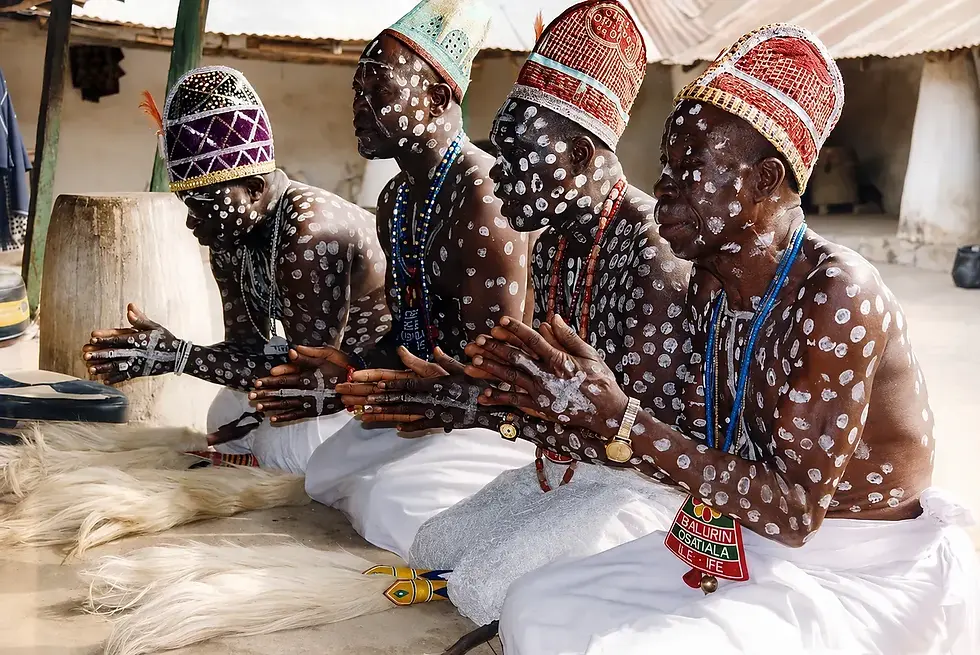
I spent years in Sudan before I understood what I had been taught not to see.
The work took me into camps and villages across the country, and the Dinka were among the people I sat with. What struck me then, and what I did not have language for until much later, was how completely their account of the world held together. Nhialic sat at the center of it. Not a spirit of the sky, though that is how it gets translated. The one above all things. Formless, without image, the condition inside which everything exists, the source of moral order, the cause standing behind what happens. People spoke about Nhialic the way people speak about monotheism anywhere else. Godfrey Lienhardt, an Oxford anthropologist lived among the Dinka for years and published Divinity and Experience in 1961, worked hard to document this.
Now put a Dinka woman in a room with a Muslim woman from Kano and a Coptic woman from Alexandria. Two of them are in a category called religion. One of them is in a category called belief. All three of them, if the conversation ran long enough, would recognize a great deal of what the others were saying.
I have been sitting with that room since my first world religions lecture in university, and what interests me now is not only how religion has become a line that separates those women. It is that I keep meeting people who want to redraw it in the other direction, and who do not notice that they are still holding the same pencil.
So why is African sacred traditions called Animism, but Christianity Religion?
In 1871 an English anthropologist named Edward Burnett Tylor published Primitive Culture and gave the world the word animism. Tylor proposed that religion develops in stages. It begins with animism, the idea that spirits inhabit trees and rivers and stones. It moves through the worship of many gods. It ends in the worship of one, and the endpoint he had in mind was European Christianity. Darwin had published On the Origin of Species 12 years earlier, and everything in Victorian Britain was being sorted into sequences that ran from simple to advanced.
He never studied the traditions he was ranking. But his theories spread anyway, because Britain was administering roughly a quarter of the planet and here was a way of describing conquest as a stage of development.
Other words did the same thing. Fetishism, coined in 1760 by Charles de Brosses, described people as worshipping objects. Henotheism described the worship of one god among several, which served as a waiting room for traditions that plainly had a supreme being and could not be permitted to have arrived. Totemism dissolved theology into sociology. James Frazer’s The Golden Bough, in 1890, ran human thought from magic to religion to science with Europe at the finish line.
The framework went into mission schools, colonial law, and the courts. It determined which marriages a government recognized and which burials it protected. Ceremonies were banned. Sacred objects went into museums, where many remain. Knowledge that had passed through hundreds of generations was interrupted by a single generation raised to be ashamed of it.
The word monotheism itself is an English invention from 1660, coined by the Cambridge Platonist Henry More in a treatise arguing with other Englishmen about atheism. It appears nowhere in the Hebrew Bible, the New Testament or the Qur’an.
Categories are hard to put down, even when you know where they came from. I notice this in the conversations happening now about African identity and faith, and I notice it in myself.
One argument I keep encountering goes like this. Christianity and Islam were imposed on Africa. They are instruments of conquest and recovering African identity means returning to what those faiths displaced, because the traditional systems are the authentic inheritance and the Abrahamic ones are the colonizer’s residue.
I understand this. Something was taken. Christian mission schools did teach children that their grandparents lived in darkness. That damage is real and people are still working to repair it. But it’s important to separate politics from religion when studying this history. Our inability to engage Abrahamic traditions more meaningfully is keeping us out from accessing deep African history. And this argument does the same thing colonial administrators did in the 19th century. It places religions into groups. Major world religions in one group, indigenous traditions in the other, and it says the two do not belong together. It drew a line between them. The only thing that changed is which side we are told to respect.
But when we look at history of Africa, it does not support this imposed divide.
Moses grew up in Egypt. The Exodus, the founding story of Judaism, takes place in Africa. Philo of Alexandria, writing in Egypt in the first century, argued that any person who thinks carefully can reach divine reason. He found that idea inside the Torah. Alexandria was the center of early Christian thought, where Origen, Clement, and Athanasius worked. Augustine, whose writing shaped Western Christianity for over a thousand years, came from what is now Algeria. The Ethiopian Orthodox Church was founded in the 4th century kingdom of Aksum. It has kept its own canon of 81 books for 16 centuries, including texts that never entered the Western Bible.
In 615, seven years before the Islamic calendar begins, Prophet Muhammad (pbuh) sent his followers across the Red Sea to escape persecution in Mecca. They went to the kingdom of Aksum and the Christian king there protected them. The first refuge of Islam was not to Persia or Jerusalem, but to Africa. This suggests a deeply connected region, not one separated the way modern maps impose.
I have lived, worked and traveled across this region for most of my life. The Horn, Sahel, Nile, the Red Sea coast. These places were never separate from each other. People and ideas moved between them constantly, for thousands of years. The map that cuts North Africa off from the rest of the continent, and cuts Middle East from both, is a recent invention. It was drawn for political reasons. It does not describe how anyone actually lived.
That answers whether the Abrahamic faiths are foreign to Africa. They are not. But I am more interested in what these African traditions actually teach. So let me put the labels aside and look at what is inside them.
The Yoruba of West Africa describe Olodumare, the source that everything comes from. Most popular accounts focus on the Orishas and present them as many competing gods. Inside the tradition, the Orishas are aspects of Olodumare that people can approach, and none of them stands above the source. E. Bolaji Idowu wrote about this in Olodumare: God in Yoruba Belief in 1962. He called it diffused monotheism. One supreme reality, reached through many doors.
The Igbo describe Chukwu, a name that combines the word for greatness with the word for the origin of being. The Oromo of Ethiopia describe Waaq, and alongside Waaq a principle called Safuu, which says the universe has a moral structure built into it and that living well means staying in line with that structure. The Akan of Ghana describe Nyame, who knows everything and is everywhere.
Along the Nile, Egyptian theology described Amun, the hidden one, the source standing behind all the named gods, thousands of years before Abraham. Egypt also produced the first state experiment in worshipping one god alone, under Akhenaten in the 14th century BCE. Jan Assmann traced the roots of monotheism back to this material in Of God and Gods in 2008.
The same pattern appears far outside Africa. The Lakota describe Wakan Tanka, one formless creator, the sacred power running through everything. In the Andes there is Viracocha, who made the world and then withdrew from it. The Rig Veda, written more than 3,000 years ago, says that truth is one and the wise call it by many names. Early Daoist philosophy describes the Tao, the nameless origin of Heaven and Earth.
From the outside, these look like different things. Different times, different places, different languages, different names. But look at the foundation and the same structure appears every time. One source at the center, with no form, existing before everything else. Smaller powers below it, closer to human life. A moral order that is part of how the universe is built rather than something added later. And human beings with obligations toward both.
That looks a lot like the structure we find in Mecca and Jerusalem and Rome.
African philosophers are debating this now, which I find encouraging. Thaddeus Metz and Motsamai Molefe argued in The Monist in 2021 that African traditional religion should be read as a form of monotheism that scholars have overlooked. Other Yoruba scholars, working from the Ifa corpus, have responded that their tradition understands God as present inside creation rather than standing outside it, and that an imported label flattens what is actually there. I find the disagreement more valuable than any single answer. It is what serious attention looks like, and it should have started 150 years ago.
I also want to be clear that Europe did not invent this kind of ranking. The habit of sorting religions and people into true and false is much older. You find it in ancient polemics against pagans, in laws that protected some communities and not others, in long arguments about who counts as People of the Book. What Europe did in the 19th century was turn that habit into a formal system, give it a diagram, and teach it in schools across half the world.
When I start to put all of this together, the Abrahamic traditions and the indigenous belief systems across the rest of the world, I see our habit of dividing and ranking them. One is real religion from God. The other is something people invented. But when I paid attention to the timeline, something starts to happen.
Humans like us have been on earth for about 300,000 years. Farming is about 12,000 years old. Writing is about 5,000. Everything we call written history covers the last 2 percent of our time here.
For the other 295,000 years, people lived, buried their dead, raised children, faced grief, and needed the world to make sense. So what was happening during those 295,000 years? Communities in Australia, the Arctic, the Americas, East Asia, and Africa spent tens of thousands of years working out how the universe fits together and what people owe to it. Did God say nothing to any of them until someone arrived carrying a book in Jerusalem or Mecca?
Taylor and the colonial system says yes. But I am more interested in what the Abrahamic scriptures actually say.
In Genesis, before Moses and before the covenant with Abraham, a man called Melchizedek appears. He is a king and a priest of God Most High. He blesses Abram, Abram gives him a tithe, and the story moves on (Genesis 14:18-20). Melchizedek belongs to no chosen line. He is already there, already knowing God, already serving as a priest, and the text treats this as normal.
In Acts, Paul tells an Athenian audience that God made every nation so that they would search for him and perhaps find him (Acts 17:26-27). Every nation.
The Qur’an says this most directly. It does not present itself as a new religion. It presents itself as the restoration of a message that God sent throughout human history, a message that was worn down over time by conquest, displacement, and forgetting. “And We certainly sent into every community a messenger” (Qur’an 16:36). “And there was never a nation except that a warner had passed among them” (Qur’an 35:24). “And messengers We have mentioned to you, and messengers We have not mentioned to you” (Qur’an 4:164).
The figure of 124,000 prophets that people often quote comes from the hadith literature rather than the Qur’an itself, and the distinction is worth keeping. The Qur’anic claim is strong enough without it. A messenger sent to every nation, in every language. 25 are named.
If we take any of this into account then it widens our understanding of revelation. The religious traditions that developed across Africa, Asia, Americas, Europe, Australia and the Pacific did not exist outside human encounter with God. Perhaps every nation, every language and every people received divine guidance of some kind, even when the names of their messengers never entered the scriptures we inherited?
Perhaps the religious traditions Europeans encountered in Africa and elsewhere are memories of encounters with the divine that long predate categories anthropology imposed upon them. The scriptures themselves give us reason to take that possibility seriously.
It took me years of sitting in other people’s villages to understand what these verses were actually saying. When I traveled to Nigeria, I learned about West African Sufi Islam and Ifa divination. Oludamini Ogunnaike examines this in Deep Knowledge in 2020. He found two traditions that developed separately arriving at remarkably similar accounts of how a person comes to know anything about God.
The Ifa divination system of the Yoruba generates 256 configurations from a binary structure and carries a large body of verse alongside it. It is still practiced and still taught. UNESCO named it a masterpiece of humanity’s oral heritage in 2005 and added it to its heritage list in 2008. It survived because the people who held it decided it was too important to put down. The Dinka relationship with Nhialic came through decades of war and displacement in songs and prayers, held in the memories of people who had every reason to let it go. I met some of them in camps where they had lost nearly everything else.
In the 1630s, in the mountains of Amhara, an Ethiopian named Zara Yaqob is said to have withdrawn to a cave and written a treatise in Ge’ez. He reasoned his own way toward God, argued against slavery, argued for the rights of women, and placed personal conscience above the authority of any church. His student Walda Heywat wrote a companion volume. The two Hatata texts are now read among the earliest works of rational philosophy written anywhere in the world, composed in an African language before Descartes published his Meditations.
Their authorship has been disputed for a century. In 1920 an Italian scholar named Carlo Conti Rossini argued that the manuscripts were forged by the European monk who found them. He offered evidence about the language. He also offered his real reason, which was that ideas like these were not to be expected from Ethiopia. Conti Rossini was an Italian colonial administrator in Eritrea, and shortly before Italy invaded Ethiopia in 1935 he published an article arguing that the country could not civilize itself and needed a colonizer. Claude Sumner took the forgery case apart in 1976. Ethiopian scholars including Amsalu Aklilu and Alemayehu Moges have defended Ethiopian authorship based on the Ge’ez itself. The argument continues. A work of that ambition, from that place, has spent a century proving that it exists.
I have spent my career in rooms where Africa is discussed as a problem to be solved. I have spent my life in places where the people being discussed were carrying knowledge that no one in those rooms had thought to ask about. Somewhere between those two worlds, I began to see how deeply the colonial habit of division survives. Ours and theirs, indigenous and foreign, authentic and corrupted, African and everything supposedly outside it. I understand the impulse to reclaim what was dismissed, suppressed or renamed. There is real work in that reclamation. But reclamation also asks us to look at the categories we are using to do it. Otherwise we carry the same tools of separation into a new house. Moving from Islam to Ifá, or from Christianity to ancestral religion, or from one prescribed identity to another, can change the language without changing the question.
Maybe the deeper work is learning and unlearning enough to stop looking for God inside categories of belonging, and to start asking what the generations before us understood about the sacred. What they got right. What they got wrong about themselves and about each other, before we inherited the need to divide. Maybe there has only ever been one conversation with the Creator, carried out in thousands of languages across every inhabited part of the earth, about where existence comes from and what binds us to it and to each other.
📖 Stolen Genius: A journey across 320,000 years of African innovation. This collection brings together the researched stories of African innovation across medicine, science, philosophy, theology, architecture, agriculture, and more, tracing the depth and continuity of African genius across the full span of human history. 📩 Pre-Order the Book
The Reading List
The ten books below are the evidence behind this thesis. They span Ge’ez, Arabic, French, Hausa, Yoruba, and English. They include primary sources written by African philosophers, Sufi scholars, theological scholars, and indigenous diviners.
1. Divinity and Experience: The Religion of the Dinka Godfrey Lienhardt Years of fieldwork among the Dinka of South Sudan. A documentation of Nhialic, the one above all things, rendered in Dinka terms rather than Western categories. The methodological standard every book on this list aspires to.
2. Nuer Religion E.E. Evans-Pritchard The companion volume. Kwoth, spirit and breath, the invisible force that permeates Nuer existence. Two Nilotic peoples, two distinct theologies, from the same Nile Valley corridor that produced the earliest Abrahamic traditions.
3. The Hatata Inquiries Zara Yaqob and Walda Heywat — Ethiopia, 1630s. Written in Ge’ez. Two Ethiopian philosophers reasoning from pure logic toward God, against slavery, for women’s rights. Written in an African language before the Enlightenment. Among the earliest works of rational philosophy composed anywhere in the world.
4. The African Caliphate: The Life, Works and Teaching of Shaykh Usman dan Fodio Ibraheem Sulaiman Over a hundred books written in Arabic and Hausa on theology, law, ethics, and governance. An African Islamic intellectual tradition documented from within it, not as an object of Western study.
5. Of God and Gods: Egypt, Israel, and the Rise of Monotheism Jan Assmann One of the world’s leading Egyptologists traces the concept of one God back to its earliest formations in ancient Egypt. The Abrahamic faiths did not arrive in Africa from outside. They emerged from a civilizational zone Africa was already part of.
6. Conversations with Ogotemmeli Marcel Griaule Thirty-three conversations with a Dogon elder of extraordinary philosophical depth. A complete account of Dogon cosmology: creation, the structure of the universe, the origin of knowledge. One elder. One tradition. A universe.
7. Ifa: An Exposition of Ifa Literary Corpus Wande Abimbola Written by a Yoruba babalawo and former Vice Chancellor of Obafemi Awolowo University. The Ifa binary system, 256 configurations through combinatorial logic, carried through oral transmission without a single textbook, recognized by UNESCO as an Intangible Cultural Heritage of Humanity.
8. Deep Knowledge: Ways of Knowing in Sufism and Ifa Oludamini Ogunnaike Tijani Sufism and Ifa divination, one Abrahamic, one indigenous, arriving at structurally identical epistemologies through completely separate paths. The book that finds the thread this essay traces.
9. African Religion: The Moral Traditions of Abundant Life Laurenti Magesa The first scholarly work to document African traditional religion as a moral and ethical system in its own right, treating it as a peer of the world’s other great traditions on its own terms.
10. The Handbook of Yoruba Religious Concepts Baba Ifa Karade The practitioner’s guide to Yoruba cosmology. Written from inside the tradition, for people who want to understand Olodumare and the Orishas not only as intellectual system but as living practice.


Comments